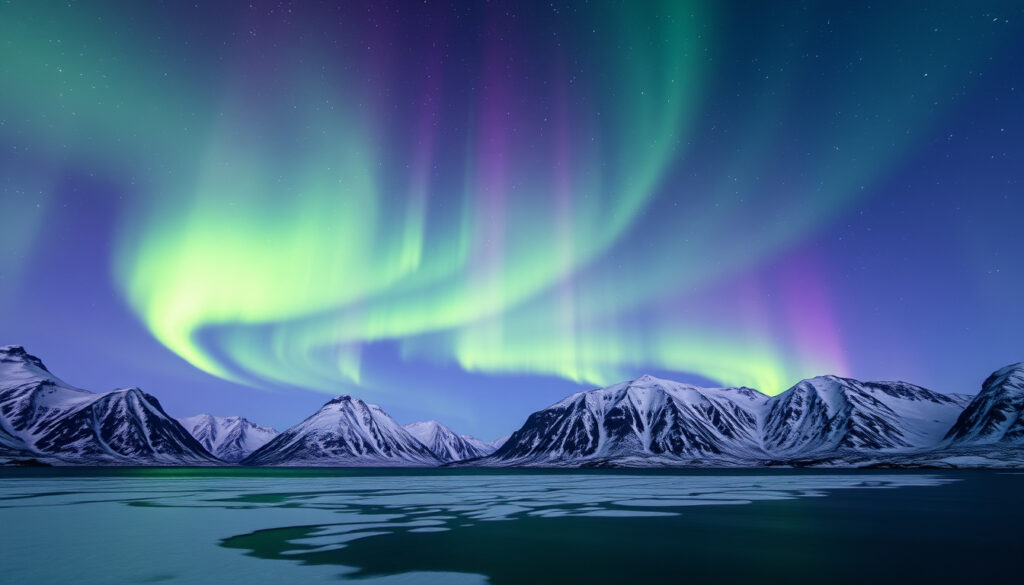
Northern Lights Forecast Tonight – Kp Index, Maps and Best Spots
The aurora borealis may put on a visible display tonight across high-latitude regions of North America and northern Europe, according to the latest space weather data. Moderate geomagnetic activity is expected, with the Kp index projected to reach levels that could make the northern lights observable from several northern-tier U.S. states and Canada under clear skies.
NOAA’s Space Weather Prediction Center indicates that solar wind conditions have strengthened sufficiently to push auroral activity into moderate ranges. While conditions do not suggest a major storm event, skywatchers positioned in favorable locations with minimal light pollution may catch glimpses of the characteristic green and sometimes red ribbons dancing across the northern horizon.
Forecasters emphasize that aurora visibility depends heavily on local weather conditions, particularly cloud cover, which remains an unpredictable variable in many regions. Those considering an outing to view the lights tonight should monitor real-time updates as the evening progresses.
Will the Northern Lights Be Visible Tonight?
Current forecasts point to a 28 percent probability of observable aurora in tracked areas, with the Kp index expected to fluctuate between 3 and 5 throughout the night. This range falls into the moderate category, meaning the lights would likely be visible from high latitudes but could appear faint or patchy for observers farther south.
The OVATION model used by NOAA generates auroral viewline predictions for North America between 6 p.m. and 6 a.m. Central Time, displaying the southernmost horizon from which the lights might be visible. Color-coded bands on probability maps indicate activity intensity, with thicker yellow, orange, or red bands suggesting stronger overhead displays visible from a wider area.
- Real-time Kp index currently reading 4, with a two-hour maximum forecast of 4
- Solar wind speed elevated at approximately 466.6 km/s
- Bz component at 0 nT; negative values would boost visibility chances further
- Density measurements at 5.04 particles per cubic centimeter
- Fast solar wind stream arriving but not fully aligned, limiting energy delivery
- Main energy burst expected within the next several hours
- No strong solar storm (G3 or higher) indicated for tonight
NOAA classifies geomagnetic storms from G1 (minor) to G5 (extreme). Tonight’s activity falls into minor-to-moderate territory, with G1-G2 conditions possible by mid-week according to some forecast models. Higher G-levels correlate with auroras visible at lower latitudes.
| Metric | Tonight’s Forecast | Notes |
|---|---|---|
| Kp Index | 3-5 (real-time: 4) | 3+ required for visibility at high latitudes |
| Solar Wind Speed | 466.6 km/s | Elevated; supports moderate aurora activity |
| Bz Component | 0 nT | Negative values enhance visibility odds |
| Density | 5.04 p/cm³ | Affects energy transfer to magnetosphere |
| Geomagnetic Activity | Minor to moderate | No G3+ storm expected tonight |
| Visibility Chance | 28% | In tracked monitoring areas |
Where Can I See the Northern Lights Tonight?
Prime Locations Across North America
Alaska remains the most reliable destination for aurora viewing tonight, with high activity potentially overhead from Utqiaġvik stretching southward through Bethel and Dillingham. Northern Canada, including areas surrounding the Yukon and Northwest Territories, offers excellent viewing potential under clear conditions.
In the continental United States, the northern tier states represent the most accessible options. Montana, North Dakota, and Minnesota sit within the projected visibility zone, though observers should manage expectations regarding brightness and duration. Canada shares comparable viewing conditions across its southern prairie provinces, with darker skies away from urban centers improving odds considerably.
European Viewing Opportunities
Northern Europe presents strong possibilities, particularly in Scandinavia. Tromsø and the Lofoten Islands in Norway consistently rank among the top forecast destinations, with real-time trackers available to confirm current conditions. Sweden’s northern regions and Finland’s Lapland fall within the probable viewing corridor, while Iceland’s rural areas away from Reykjavík light pollution offer darker skies.
Seek locations at least 30-40 kilometers from major urban centers. Higher elevations with unobstructed northern horizons improve visibility. Check cloud cover forecasts for your specific location, as regional weather patterns can override even favorable geomagnetic conditions. The aurora often appears as a faint glow on the northern horizon before becoming more defined.
Mid-Latitude Prospects
Mid-latitude sightings become possible if the Kp index reaches 5 or higher, though such displays would likely remain faint and brief tonight given the partial solar wind arrival from a coronal hole. Southern observers may wish to monitor NOAA’s Ovation map for real-time probability bands, as occasional stronger pulses could push visibility further south than baseline predictions.
Those residing in areas like Where Is Tumbler Ridge – Location, Map and Key Facts in BC may find that northern British Columbia offers surprisingly good viewing during moderate storms, though tonight’s forecast favors locations further north.
What Time and Conditions for Northern Lights Tonight?
Current Geomagnetic Activity
The geomagnetic environment supporting tonight’s aurora stems from a fast solar wind stream traveling at approximately 466.6 kilometers per second. While this stream has begun arriving, forecasters note it lacks full alignment with Earth’s magnetosphere, which limits the energy available to generate bright displays. The main energy burst remains expected within the forecast period.
The Bz component of the interplanetary magnetic field currently sits at 0 nT. This value represents a neutral state; when Bz turns negative (pointing south), it couples more efficiently with Earth’s magnetosphere and typically enhances aurora intensity. Space weather scientists track this parameter closely, as even brief negative excursions can meaningfully improve viewing conditions.
Viewing Conditions and Tips
Successful aurora watching tonight depends on several controllable and uncontrollable factors. Clear skies rank among the most critical elements, as cloud cover can completely obscure even vigorous displays. Temperature also warrants consideration; Arctic and sub-Arctic locations can drop significantly after sunset, making appropriate clothing essential for extended viewing sessions.
Light pollution management improves odds substantially. Turning off nearby lights, positioning away from streetlamps, and allowing 15-20 minutes for eyes to adjust to darkness helps observers detect fainter auroral features. When the Kp index exceeds 3, the lights often remain visible beyond the directly overhead oval due to atmospheric refraction, meaning looking slightly north of straight up may reveal activity.
Those planning to capture photographs should note that smartphone cameras increasingly can detect auroral light that eyes struggle to perceive, particularly in long-exposure modes. A sturdy tripod and clear northern exposure form the foundation of successful aurora photography.
Forecasts for Sunday night project the Kp index dropping to 2-4, with Monday likely seeing further weakening to 2-3. This declining trend means tonight presents the better viewing window for the immediate future, though some older forecast models suggest G1-G2 conditions could return by Tuesday or Wednesday of next week.
Hourly Forecast Timeline
The most favorable window for aurora viewing tonight spans approximately three hours, centered on the 21:00-00:00 UTC period when solar wind conditions, Kp levels, and cloud windows align optimally.
- 18:00-20:00 UTC: Kp index building toward evening peak; solar wind conditions supportive; initial display possible at high latitudes
- 20:00-21:00 UTC: Activity ramping up; real-time Kp readings climbing toward 4-5 range; best viewing begins in Alaska and northern Canada
- 21:00-00:00 UTC: Prime window; peak Kp expected between 3.67 and 5; optimal solar wind alignment; highest probability across all monitored regions
- 00:00-02:00 UTC: Activity declining as geomagnetic conditions start easing; remaining opportunities at highest latitudes
- 02:00-04:00 UTC: Kp dropping toward 3 or below; visibility increasingly limited to polar regions
Live updates from NOAA’s dashboard and services like AuroraHunter provide precise hourly Kp readings that may shift these estimates. Observers should check these resources closer to their planned viewing time for the most current data.
What We Know and What Remains Uncertain
Tonight’s aurora forecast rests on solid observational foundations, yet meaningful uncertainties persist that observers should understand before heading outside.
| Established Information | Remaining Uncertainties |
|---|---|
| Real-time Kp index at 4, projected 3-5 range | Exact timing of peak within the viewing window |
| Solar wind speed at 466.6 km/s | Whether the main energy burst arrives tonight or shifts to tomorrow |
| Clear visibility possible at high latitudes | Local cloud cover in specific viewing locations |
| 28% visibility probability in monitored areas | Whether Bz will turn negative to boost intensity |
| Tonight superior to Sunday/Monday forecasts | Whether mid-latitude observers will see anything tonight |
| Alaska, Canada, northern Europe in probable zone | Duration and brightness of any display |
The NOAA Ovation model’s 20-40 minute forecast cycles help address some uncertainty by updating probability bands regularly. However, the inherently chaotic nature of space weather means that actual conditions can diverge from predictions, sometimes significantly within hours.
Understanding the Science Behind Tonight’s Display
The aurora borealis arises from charged particles from the Sun colliding with atoms and molecules in Earth’s upper atmosphere. Solar wind constantly streams outward from the Sun, but events like coronal holes—areas where the solar corona appears darker in X-ray and extreme ultraviolet images—can release faster streams that enhance geomagnetic activity when they reach Earth.
Tonight’s moderate activity connects to such a coronal hole structure, though the stream’s orientation relative to Earth has not provided optimal coupling. The Kp index, developed by Gauss in the 19th century and refined over decades, provides a standardized measure of planetary geomagnetic activity on a 0-9 scale. Each whole number increment roughly doubles the energy input from the solar wind, translating to auroras visible progressively further from the poles.
Color variations in auroral displays depend on which atmospheric gases dominate the interaction and at what altitude collisions occur. Oxygen molecules at altitudes above 200 kilometers produce characteristic green and red hues, while nitrogen interactions lower in the atmosphere generate blue and purple tones. Tonight’s moderate conditions favor green displays, with red more likely during stronger storms.
Tracking Resources and Credible Sources
Several authoritative resources enable observers to follow tonight’s conditions in real time and adjust their viewing plans accordingly.
NOAA’s Space Weather Prediction Center remains the primary authoritative source for aurora forecasting in the United States. Their experimental aurora dashboard provides 30-minute estimates and viewline maps showing probable visibility boundaries.
— NOAA Space Weather Prediction Center
- NOAA Aurora Viewline — Night-by-night visibility boundaries for North America
- SpaceWeatherLive — Kp index forecasts and auroral activity tracking
- Geophysical Institute Alaska — Live aurora cameras and regional forecasts
- AuroraForecast.me — City-specific forecasts covering over 1,000 locations with cloud cover data
- PolarForecast — Real-time Kp, solar wind metrics, and visibility chances for cities like Tromsø
- SoftServeNews — Ovation model confirmation and probability map interpretation
Probability maps use color-coded bands to indicate visibility likelihood. Thick yellow, orange, or red bands suggest strong overhead activity visible from a wider area, while thinner bands indicate more limited visibility concentrated near the poles.
— SoftServeNews/Aurora Analysis
Summary and Viewing Recommendations
Tonight offers a moderate opportunity to observe the northern lights across high-latitude regions of Alaska, Canada, and northern Europe. The Kp index is expected to range between 3 and 5, with the best viewing window spanning 21:00 to 00:00 UTC. A 28 percent visibility probability in monitored areas reflects the partial alignment of incoming solar wind, which limits intensity but still permits observable displays at higher latitudes.
Successful viewing tonight depends primarily on escaping light pollution and finding locations with clear skies. The How Many Lakes in Canada – Counts, Facts and Comparisons resource highlights how Canada’s extensive northern territories offer vast dark-sky regions ideal for aurora watching, far from the light pollution that affects southern population centers.
Those wishing to maximize their chances should monitor real-time updates from NOAA’s aurora dashboard or PolarForecast as the viewing window approaches. Tonight presents a better probability than the declining forecasts expected Sunday and Monday, though some models suggest renewed activity could return by mid-week.
Frequently Asked Questions
How accurate are northern lights forecasts?
Aurora forecasts typically prove reliable for 24-48 hours regarding general activity levels, but precision decreases beyond that range. Hourly and 30-minute updates provide more accurate near-term assessments, though inherent space weather variability means actual displays can differ from predictions.
What does the Kp index mean for visibility?
The Kp index ranges from 0-9 and measures global geomagnetic activity. Values 0-2 indicate very low activity visible only near the poles. Values 3-4 support visibility at high latitudes. Values 5+ can push sightings to mid-latitudes. Tonight’s 3-5 range suggests high-latitude visibility is likely.
What time should I go outside to see the lights?
The prime viewing window tonight spans 21:00 to 00:00 UTC. For local conversion, subtract appropriate hours from UTC. In the U.S. Eastern Time zone, this translates to approximately 4:00-7:00 p.m. local time; Pacific Time corresponds to 1:00-4:00 p.m.
Will I be able to see the aurora from my location?
Location determines baseline feasibility. High latitudes (Alaska, northern Canada, Scandinavia) have strong potential. Northern-tier U.S. states like Montana and Minnesota could see faint displays if conditions align favorably. Southern locations require Kp 5+ for any realistic chance.
What equipment do I need for aurora viewing?
No special equipment is required for viewing. Dark-adapted eyes work best, so avoid looking at phones or bright lights. A clear northern horizon and patience are essential. Those wishing to photograph the aurora benefit from smartphones with night modes or dedicated cameras on tripods.
How long do aurora displays last?
Aurora displays vary enormously in duration. Individual bursts may last minutes, while complete viewing sessions can extend hours. Tonight’s moderate conditions suggest any displays, if they occur, would be more likely to appear in shorter bursts rather than sustained shows.
Does moonlight affect aurora visibility?
Moonlight has minimal impact on bright auroral displays, but during moderate or weak activity, a bright moon can compete with the aurora’s glow. Tonight’s moon phase should not significantly hinder viewing at high latitudes where aurora intensity is strongest.
What causes the different colors in auroras?
Green auroras dominate at lower altitudes where oxygen molecules are abundant. Red auroras occur at higher altitudes where oxygen dominates at lower densities. Blue and purple tones result from nitrogen interactions. Tonight’s moderate activity favors green displays with possible red at the display edges.
More related posts
 Wild Cards (TV Series): Season 3, Where to Watch, Reviews
 Gabrielle Union: Health, Net Worth, Age and More
 Kitchener Airbnb Ceiling Collapse: What’s Confirmed, What’s Not
 Free AI Video Generators: 2025 Comparison Guide
 Best Credit Cards for Travel 2026: Compare Top Picks & Rules
 Free TV Streaming Sites – Best Legal Options 2024
 How Long I the Minecraft Movie? Runtime & Detail
 Marcus Rashford: Bio, Career, Family, and Future Guide