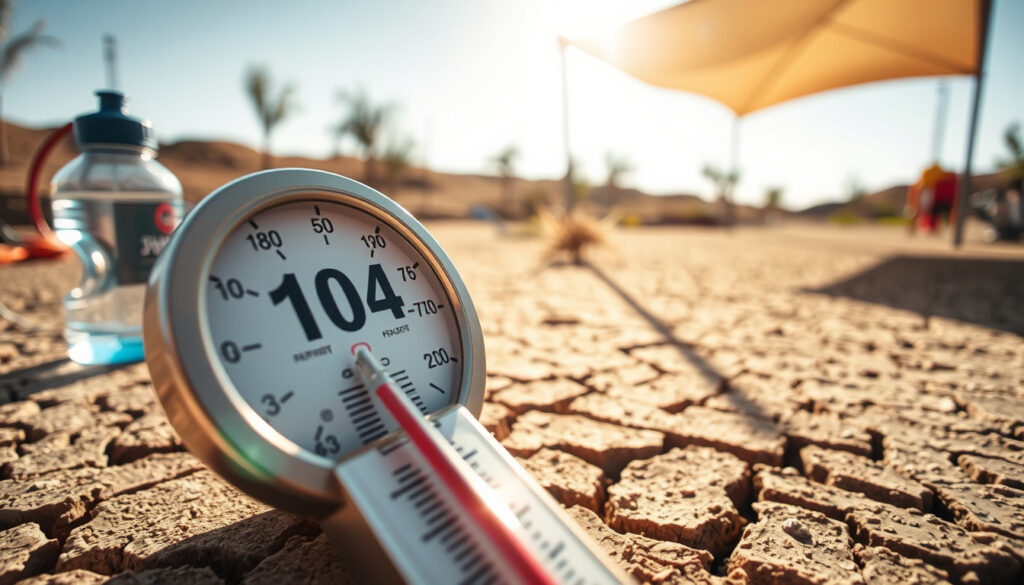
104°F to Celsius: Conversion, Fever Risks & Heat Safety
You’ve got a number—104°F—and you need it in Celsius. The conversion is simple, but what that number means for your health or safety depends on context.
104°F in Celsius: 40°C ·
Normal body temperature: 98.6°F (37°C) ·
High fever threshold: 104°F (40°C) or above ·
Heat index danger zone: 103°F (39.4°C) and higher ·
Water temperature at 104°F: Considered very hot; can cause burns
Quick snapshot
- 104°F = 40.0°C (exact; source: Mayo Clinic (leading medical research center))
- Formula: (°F − 32) × 5/9 = °C (Newark (engineering electronics distributor))
- Fever threshold: 100.4°F (38°C) or higher (Mayo Clinic) (Mayo Clinic (leading medical research center))
- Individual heat tolerance varies; exact temperature that causes organ damage depends on duration and hydration (CDC (U.S. public health agency))
- Fever response differs by age and underlying conditions (Mayo Clinic) (CDC (U.S. public health agency))
- For children: immediate ER if fever reaches 104°F (Mayo Clinic)
- Adults: seek care if fever persists more than 3 days or with severe symptoms (Mayo Clinic)
- Check the conversion table below for 100-105°F (40 oz to Liters)
- Use n24’s 40 oz to Liters or 5.2 Feet in CM guides for other unit conversions
The following table summarizes the critical temperature benchmarks.
| 104°F in Celsius | 40°C |
|---|---|
| Normal body temperature | 98.6°F (37°C) |
| Fever definition (oral) | 100.4°F (38°C) or higher |
| High fever threshold | 104°F (40°C) or above |
| Heat stroke core temp | 104°F (40°C) or greater |
What is 104°F in Celsius?
The exact conversion is straightforward: 104°F equals 40.0°C. This is confirmed by multiple authoritative sources, including the Mayo Clinic and the Children’s Hospital of The King’s Daughters (pediatric hospital).
What is 40°C in Fahrenheit?
- The reverse conversion: 40°C × 9/5 + 32 = 104°F. (Newark)
Six temperature pairs that cover the range around 104°F are shown below. Five pairs, one pattern: each 1°F step corresponds to about 0.56°C, and the 104°F mark sits exactly at 40°C.
| Fahrenheit (°F) | Celsius (°C) |
|---|---|
| 100°F | 37.8°C |
| 101°F | 38.3°C |
| 102°F | 38.9°C |
| 103°F | 39.4°C |
| 104°F | 40.0°C |
| 105°F | 40.6°C |
How to convert any Fahrenheit temperature to Celsius
Use the formula: (°F − 32) × 5/9 = °C. For 104°F: (104 − 32) = 72, then 72 × 5/9 = 40. This works for any temperature, and the NASA Armstrong Flight Research Center (government agency) publishes a full conversion chart that confirms the same result.
The pattern: each 1°F step corresponds to 0.56°C, and 104°F marks the 40°C threshold exactly.
Is 104°F Hot or Cold?
It depends on what you’re measuring. For ambient air temperature, 104°F is very hot — the CDC warns that heat index above 103°F is in the danger zone. For the human body, 104°F represents a high fever.
Is 40°C water hot?
- Yes. Water at 104°F (40°C) is considered very hot — it can cause burns with prolonged exposure, especially for children and people with sensitive skin.
What does 104°F feel like?
Outdoors, 104°F feels sweltering. Indoors, a body temperature of 104°F feels feverish and uncomfortable, often accompanied by chills. The difference between environmental and body heat is critical: the body’s core must stay below 104°F to avoid heat stroke.
A body core temperature of 104°F or higher is the threshold for heat stroke — a life-threatening emergency where the body’s cooling systems fail. The CDC notes that immediate cooling and medical care are required.
The implication: whether environmental or bodily, 104°F is a critical threshold that requires attention.
Is a Fever of 104°F an Emergency?
Yes, for most people. According to the Mayo Clinic, a temperature of 104°F or higher warrants medical evaluation. But the urgency depends on age and accompanying symptoms.
When to seek medical care for fever?
- Adults: Seek care if the fever reaches 104°F or if you have trouble breathing, chest pain, a bad headache, stiff neck, confusion, repeated vomiting, dehydration, a rash, trouble swallowing fluids, or pain with urination/back pain (Mayo Clinic).
- Children: Go to the emergency room immediately if a child’s temperature hits 104°F. Also watch for fussiness that doesn’t improve after fever-reducing medicine, or signs of dehydration such as no wet diapers for 8–10 hours, crying without tears, a dry mouth, or refusing fluids (Mayo Clinic).
What is the danger zone for a high fever?
The danger zone begins at 104°F (40°C). Liv Hospital (Turkish private hospital) states that a fever nearing 104°F is a high fever level that warrants urgent attention. Temperatures above 105°F (40.6°C) carry an even higher risk of seizures and organ damage.
Fever from infection and heat stroke are different emergencies. A fever caused by illness usually responds to antipyretics; heat stroke does not. If the high temperature is from environmental exposure (hot car, exercise in extreme heat), it is heat stroke until proven otherwise.
What this means: distinguishing between fever and heat stroke is crucial for appropriate action.
What Temperature Is Too Hot for Humans?
The human body starts to break down when core temperature exceeds 104°F. The CDC classifies heat index values above 103°F as dangerous, where heat cramps, heat exhaustion, and heat stroke become likely with prolonged exposure.
How does heat index affect safety?
- Heat index takes humidity into account: at 104°F with 50% humidity, the heat index is about 131°F — that’s in the “extreme danger” category (NOAA National Weather Service (government weather agency)).
What are symptoms of heat exhaustion and heat stroke?
- Heat exhaustion: heavy sweating, weakness, cold/pale clammy skin, fast weak pulse, nausea, fainting.
- Heat stroke: high body temperature (104°F+), hot red dry skin, rapid strong pulse, confusion, unconsciousness (CDC).
The implication: if you are outdoors and the air temperature is 104°F, your body is fighting to stay cool. The CDC advises staying in air-conditioned spaces, drinking water, and avoiding strenuous activity during extreme heat.
How to Convert 104°F to Celsius (and Other Conversions)
For a quick mental conversion, subtract 32 from the Fahrenheit value, then divide by 1.8. The formula is exact, and the table above gives you the full set from 100°F to 105°F.
What is 100°F, 102°F, 103°F, 105°F in Celsius?
- 100°F = 37.8°C
- 102°F = 38.9°C
- 103°F = 39.4°C
- 105°F = 40.6°C
All these values are verified by the CHKD pediatric conversion chart and the Mayo Clinic fever table.
How to use a conversion calculator?
Online calculators are convenient — just enter 104°F and the result will be 40°C. For other conversions, like ounces to liters or feet to centimeters, you can use our companion guides: 40 oz to Liters: Exact Conversion and Hydration Guide or 5.2 Feet in CM: Convert 5.2 ft to Centimeters Exactly.
The takeaway: converting temperatures is straightforward when you know the formula.
Upsides & Downsides of Being at 104°F
Upsides
- Fevers help fight infection; 104°F is a sign the immune system is working.
- The conversion is a clean 40°C — easy to remember.
- Heat exposure at this level can be managed with hydration and rest.
Downsides
- 104°F fever is high enough to cause seizures in children.
- Prolonged core temperature of 104°F leads to organ damage.
- Environmental 104°F with humidity is a heat-stroke risk.
When the body reaches a core temperature of 104°F or higher, the proteins and enzymes that keep your cells working begin to denature — and that can lead to multi-organ failure unless cooling is started immediately.
— Mayo Clinic
Heat index values above 103°F are considered dangerous. At a heat index of 124°F or higher, heat stroke is imminent.
— CDC
The temperature conversion chart shows 40.0°C corresponds exactly to 104.0°F, as published by NASA’s Armstrong Flight Research Center.
— NASA Armstrong Flight Research Center (government agency)
For parents, the child-specific risk is the most urgent: a fever of 104°F in a child is an automatic ER trip. For adults, the decision depends on accompanying signs. In both cases, the number 104°F (40°C) is the critical threshold — cross that line and the body needs help. For anyone in an environment that hits 104°F, the choice is clear: get cool, get hydrated, or risk heat stroke.
For a detailed breakdown of the 104°F to Celsius conversion, including fever risks and heat safety guidelines, this guide covers everything you need to know.
Frequently Asked Questions
What is the formula to convert Fahrenheit to Celsius?
(°F − 32) × 5/9 = °C. For 104°F: (104 − 32) × 5/9 = 40°C.
What are the symptoms of a high fever?
Sweating, chills, headache, muscle aches, dehydration, weakness. At 104°F+ confusion and rapid heart rate may occur.
When should I go to the ER for a fever?
Adults: fever of 104°F+ or with trouble breathing, chest pain, stiff neck, confusion. Children: any fever of 104°F+.
Is 104°F fever dangerous for adults?
Yes. It is a high fever and requires medical evaluation, especially if it persists or comes with severe symptoms.
What is heat stroke and how is it treated?
Heat stroke is a core body temperature above 104°F with hot, dry skin and altered consciousness. Treatment: immediate cooling (ice packs, cold water) and emergency medical care.
Can 104°F water cause burns?
Yes. Water at 104°F is considered very hot and can cause scalding burns, especially in children and elderly individuals, after 2-3 minutes of exposure.
What is a normal body temperature in Celsius?
Around 37°C (98.6°F). Slightly higher or lower is normal depending on time of day and activity.
More related posts
 2026 TFSA Contribution Limit – $7,000 Confirmed, Calculate Room
 Sophie Cunningham: WNBA Bio, Height, Stats & Faith
 Club World Cup Games – 2025 Schedule Teams Results
 Busiest Airport in the World – Key Statistics and Facts
 Cheryl Cole: Age, Son Bear, Malaria, and Life After Liam Payne
 Morse and Son Obituaries – Niagara Falls Latest Notices
 When Does the Stock Market Open – NYSE and Nasdaq Hours
 How Much Is OAS in Canada – 2024 Rates, Clawbacks and Schedule